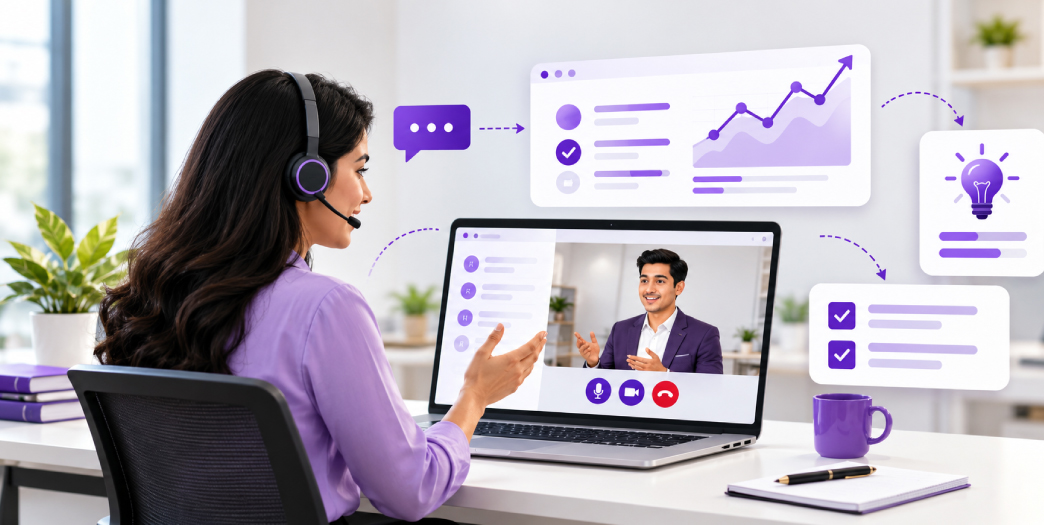

AI role-play sales training software should do more than simulate a buyer and score a sales conversation. It should help sales reps understand where their approach falls short, practice the specific behaviors they need to improve, and give learning teams a way to track progress over time.
The challenge is connecting those steps. Feedback may identify a missed discovery question or an ineffective response to an objection, but improvement requires another opportunity to practice that skill in context.
PersonaTrain.ai addresses this challenge through a multi-agent architecture that connects real-time evaluation with scenario progression, company-specific knowledge, and performance-informed scenario recommendations. This creates a more structured approach to sales practice, helping teams move beyond isolated scores toward targeted skill development.
For enterprise L&D and sales enablement leaders, the question is no longer simply whether AI can evaluate a sales conversation. It is whether the platform can turn that evaluation into relevant practice and meaningful evidence of progress.
Why AI Sales Role-Play Scoring Alone Doesn’t Improve Rep Behavior
Consider a rep who answers product questions accurately but moves into a pitch before understanding the customer’s problem. The rep may demonstrate strong product knowledge and still miss the opportunity to uncover the buyer’s needs.
A useful assessment should distinguish these behaviors. Otherwise, an overall score can hide a weakness that matters in a real sales conversation.
Ambition’s 2026 State of Sales Coaching survey illustrates a related problem. Among 312 sales leaders and managers surveyed, 77% reported having a coaching framework, but only 38% said it was consistently adopted across their managers. These figures concern coaching practices within revenue organizations, not individual sales reps. They highlight the difference between having a process and applying it consistently.
AI sales coaching software can help make practice more available. But availability alone doesn’t guarantee that the practice addresses the right behavior.
The difference between a performance score and actionable coaching
Useful feedback answers three questions:
- What happened? Identify the specific behavior, not just the final score.
- Why did it matter? Explain its effect on the customer or the conversation’s objective.
- What should happen next? Give the rep a clear behavior to practice.
For example, instead of telling a rep to improve discovery, feedback could point out that the rep recommended a solution before clarifying the customer’s current process.
That gives the learner something concrete to work on in the next conversation.
How AI Role-Play Sales Training Software Evaluates Sales Conversations
AI role-play sales training software simulates customer-facing conversations and evaluates how learners respond against defined criteria. Depending on the platform, those criteria may cover product knowledge, discovery, objection handling, communication, empathy, and compliance.
The assessment is only as useful as its design. If a rubric rewards mentioning product features but doesn’t assess whether those features address the customer’s needs, a rep can score well without demonstrating effective selling.
What scoring, feedback, and progress tracking actually measure
These three capabilities serve different purposes:
| Capability | What it tells you |
|---|---|
| Scoring | How the rep performed against defined criteria |
| Feedback | Which behaviors were effective or need to change |
| Progress tracking | Whether performance changes across practice attempts |
The design should also reflect the sales methodology the organization expects reps to follow. A discovery conversation, renewal discussion, and pricing negotiation shouldn’t necessarily use the same criteria.
Scoring and feedback are already established features across the AI sales role-play category. Second Nature describes personalized AI feedback, performance tracking, and knowledge-gap reporting. PitchMonster describes scorecards and AI-assisted coaching debriefs.
The differentiator isn’t simply whether a platform provides scores or feedback. Buyers need to understand how its assessment works and what the system does with the resulting information.
How PersonaTrain.ai Connects Evaluation With Adaptive Practice
Evaluation and scenario progression serve different purposes. Evaluation assesses the learner’s behavior; scenario progression manages how the conversation develops. When these responsibilities work together, the training experience can support more focused practice than a fixed sequence of scripted questions.
PersonaTrain.ai documents both a Real-Time Evaluation Agent and a Scenario Progression Agent within its six-agent architecture. The former assesses learner responses against defined criteria, while the latter tracks scenario milestones and guides the conversation toward its objectives.
What the Real-Time Evaluation Agent does
The Real-Time Evaluation Agent assesses learner performance throughout the conversation against configured evaluation criteria. These can address behaviors such as product knowledge accuracy, objection handling, communication clarity, and compliance.
This provides a specific architectural explanation for how evaluation is handled, rather than referring to scoring as an unexplained AI capability.
However, a dedicated evaluation agent doesn’t automatically prove that scores are accurate or unbiased. Enterprise teams should test assessments against expert-reviewed examples and confirm that feedback reflects their competency standards.
How the Scenario Progression Agent changes the conversation
The Scenario Progression Agent tracks where the learner is in the scenario, which topics have been covered, and whether the conversation should move forward, introduce a complication, or conclude.
This matters because effective practice isn’t always about repeating the same challenge.
A rep who handles an objection well may be ready for a more complex follow-up. A rep who misses an important discovery question may need another opportunity to explore the customer’s needs before progressing.
The scenario should remain aligned with its learning objectives rather than becoming unpredictable for its own sake.
From a missed discovery question to targeted practice
Imagine a rep practicing with an AI buyer who is considering a new software platform.
The rep immediately presents product features without asking about the buyer’s existing workflow. The evaluation identifies the missed discovery behavior. The next practice opportunity can focus on uncovering business needs before recommending a solution.
The learning team can then assess whether the rep asks relevant questions, listens to the answers, and connects the recommendation to the buyer’s priorities.
PersonaTrain also describes smart scenario recommendations based on performance history and skill gaps. This extends the approach beyond managing the current conversation to helping learners identify relevant subsequent practice. It is an important distinction: adapting a conversation within a session and recommending what a learner should practice next are related, but different, capabilities.
Why Company Knowledge Matters in AI Sales Training
A realistic buyer persona isn’t enough if the conversation uses the wrong product information.
PersonaTrain.ai’s Knowledge Retrieval Agent retrieves relevant information from uploaded organizational documents. Its Guardrail Agent checks generated responses against retrieved information and applicable constraints.
For sales enablement teams, this creates an opportunity to build practice around actual product documentation, approved messaging, policies, and sales processes. A rep can practice responding to a pricing objection using the organization’s product context rather than relying entirely on a generic sales example.
The wider architecture has two other responsibilities. The Character Agent maintains the configured persona and its behavior, while the Orchestrator coordinates the agents so the learner experiences one coherent conversation.
Together, the six agents have distinct roles:
- Orchestrator: Coordinates the agent workflow.
- Knowledge Retrieval Agent: Retrieves relevant organizational information.
- Character Agent: Maintains the configured buyer persona.
- Scenario Progression Agent: Manages conversation development.
- Guardrail Agent: Checks responses against relevant information and constraints.
- Real-Time Evaluation Agent: Assesses learner performance.
This separation helps enterprise buyers understand how the platform is designed, rather than evaluating it as a single, opaque AI feature.
L&D teams still need to review source content, define suitable evaluation criteria, and validate scenarios before deployment. Knowledge grounding and guardrails support the learning experience, but they don’t eliminate the need for subject matter review.
How Do You Measure Improvement Beyond an AI Role-Play Score?
Measure AI sales training at three levels: performance during practice, behavior in real conversations, and relevant business outcomes. A higher simulation score is useful evidence, but it isn’t proof of better sales performance.
| Measurement | What to examine |
|---|---|
| Practice performance | Discovery questions, objection handling, product accuracy, and rubric scores |
| Transfer to work | Whether target behaviors appear in subsequent live sales conversations |
| Business outcomes | Conversion rates, sales-cycle duration, ramp time, or quota attainment, where relevant |
Start with a defined behavior. If the goal is better discovery, assess whether reps consistently uncover customer needs during simulations. Then examine available call evidence to see whether that behavior appears in real conversations.
Business outcomes need more careful interpretation. Conversion rates and quota attainment are affected by factors beyond training, including lead quality, territory, pricing, and market conditions. Avoid attributing changes to AI role-play without a suitable evaluation design.
For L&D leaders, the objective is to build a credible chain of evidence from practice to workplace behavior, then to business results where the data supports that connection.
What Should Enterprises Look for in AI Sales Role-Play Software?
Enterprise buyers should evaluate how the platform assesses behavior, adapts practice, uses company knowledge, and fits existing workflows. A long feature list won’t tell you whether the system can support your learning objectives.
Assessment reliability, knowledge grounding, and governance
During a vendor evaluation, ask:
- Assessment: Can the platform evaluate behavior against your competency rubric and explain its feedback?
- Consistency: How will your team test scores against expert-reviewed examples?
- Knowledge grounding: Can scenarios use approved product documentation, sales playbooks, policies, and procedures?
- Adaptation: Does the platform change the conversation based on learner responses, and what determines that change?
- Governance: Can subject matter experts review scenarios, criteria, and feedback before rollout?
These questions matter particularly in regulated industries or high-stakes conversations, where incorrect product claims or inconsistent guidance can create real business risk.
Integration, reporting, and deployment requirements
A platform also needs to fit the organization’s operating model. Check how learners access practice, how administrators assign scenarios, and what reporting managers can use to identify coaching needs.
PersonaTrain documents text-based, voice-based, and photorealistic video-avatar practice. It also supports deployment through Microsoft Teams, a standalone web app, or embedding in an existing LMS, intranet, or onboarding portal.
Confirm the exact integration, reporting, security, and administrative requirements with the vendor. An available deployment option doesn’t automatically mean every workflow or system integration is supported.
The strongest buying decision connects the technology to a defined capability gap, a clear practice model, and an agreed method for evaluating results.
PersonaTrain.ai brings together real-time evaluation, scenario progression, knowledge retrieval, and performance-informed scenario recommendations. If you’re evaluating AI role-play for your organization, explore PersonaTrain.ai to see how its architecture fits your sales competencies, coaching process, and existing learning environment.
Frequently Asked Questions About AI Sales Role-Play Training
What is AI role-play sales training software?
AI role-play sales training software lets sales reps practice realistic customer conversations with AI-powered personas. It can simulate objections, discovery calls, and negotiations while evaluating responses against defined criteria and providing feedback to help reps improve specific selling behaviors.
How does PersonaTrain.ai use AI agents for sales role-play training?
PersonaTrain.ai uses a six-agent architecture with separate responsibilities for evaluation, scenario progression, knowledge retrieval, character behavior, guardrails, and orchestration. Its Real-Time Evaluation Agent assesses learner performance, while its Scenario Progression Agent manages how the conversation develops.
Can AI role-play software personalize practice based on a sales rep’s weaknesses?
Yes, depending on the platform’s capabilities. Some systems adapt conversations during a simulation, while others can recommend subsequent scenarios based on performance history and skill gaps. Buyers should verify which capabilities are available and how assessment results influence the next practice opportunity.
Can PersonaTrain.ai fit into an existing enterprise learning environment?
PersonaTrain.ai documents deployment through Microsoft Teams, a standalone web app, and embedding in an existing LMS, intranet, or onboarding portal. Confirm the specific integration, reporting, and administrative requirements with the vendor before deployment.
